BMW X5 Generations Ranked: E53, E70, F15 and G05
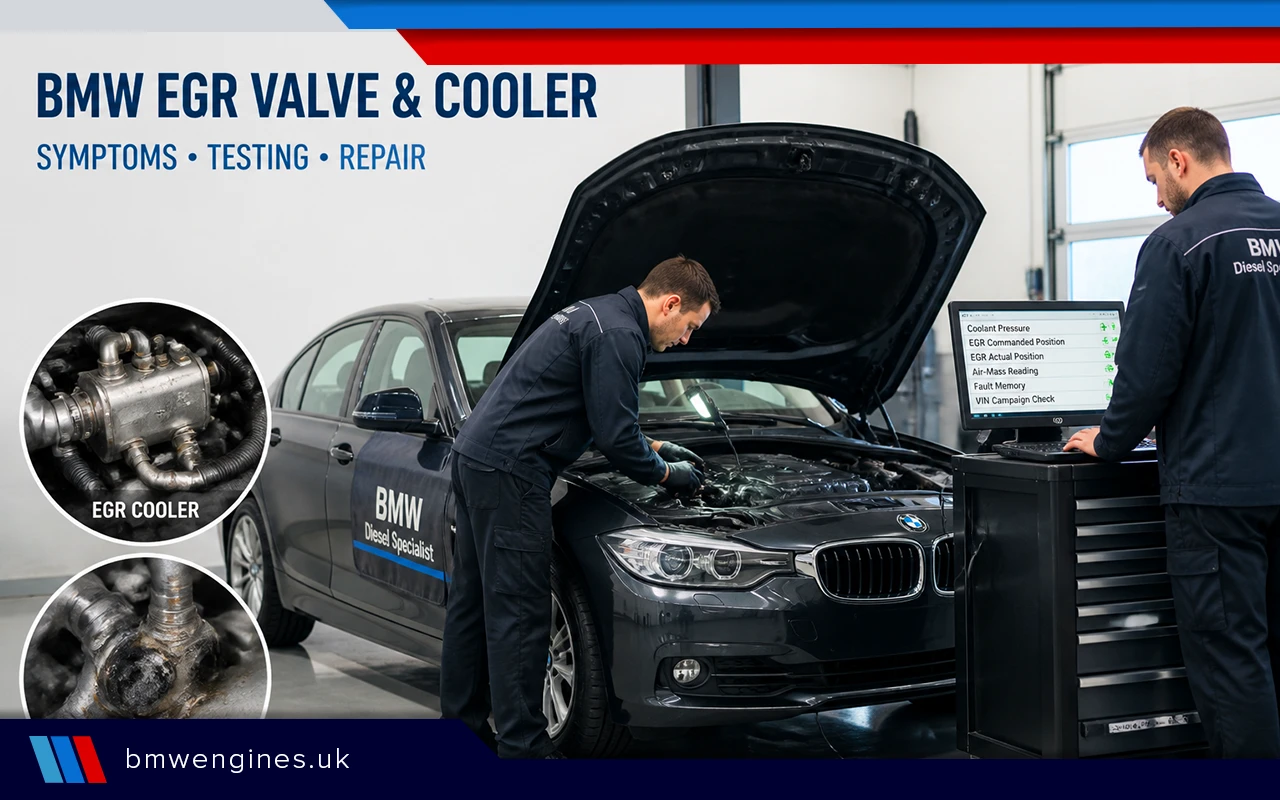
The X5's generational value spread from a £2,000 E53 to a £65,000 G05 means a single engine failure can either total the car or be a routine repair, making generation choice the most financially decisive factor in X5 ownership.
This guide ranks every BMW X5 generation from worst to best, using real UK repair costs, failure pattern data, and verified enquiry volumes. Whether you're buying your first X5 or upgrading, you'll know exactly which generation to choose—and which to avoid.
The Short Answer
Best generation: G05 (2018–present) — the only X5 with the reliable B57 and B58 engines. Replacement cost is under 30% of the car's value.
Worst: generation: E53 (1999–2006) — a £2,500 engine replacement on a £2,000 car is a write-off. Only buy for classic appeal.
Most popular in our data: F15 (2013–2018) — 288 enquiries [EM-VERIFIED]. Borderline generation—check the engine code.
Generation to avoid: E70 (2007–2013) — N57 timing chain failures and N63 hot-vee V8 problems make this a costly gamble.
Engine to prioritise: B57 diesel in the G05 — robust, modern, and replacement economics are favourable.
How We Rank BMW X5 Generations
Our Generation Score is an editorial assessment built from 24,650 UK enquiries and 20+ vetted BMW specialists. It is not a customer review score.
We score each generation using a representative engine and five dimensions:
Reliability (0–20): — documented failure patterns and severity.
Repair Cost (0–20): — the midpoint cost of a reconditioned engine supply.
Repairability (0–20): — how difficult and labour-intensive the engine is to work on.
Parts Supply (0–20): — how readily available replacement parts are in the UK.
Replacement Economics (0–20): — the recon cost as a percentage of the lowest-value host vehicle.
These scores are derived from our proprietary enquiry data, direct supplier quotes, and specialist interviews. Evidence confidence is High for all four generations, based on 288 (F15), 218 (E70), 174 (G05), and 73 (E53) [EM-VERIFIED] enquiries.
BMW X5 Generations Ranked
Generation (Chassis)
Years
Primary Engines
Request Volume [EM-VERIFIED]
Typical UK Value [THIRD-PARTY]
Recon Cost
R-to-V Flag
Verdict
E53
1999–2006
M57 3.0d, M62 V8
73
£2,000–£6,000
£1,800–£5,500
🔴 Scrap Threshold
Classic appeal only — the engine cost is worth more than the car
E70
2007–2013
N57 3.0d, N63 V8
218
£5,000–£14,000
£4,500–£10,000
⚠️ Watch
N63 hot-vee V8 examples are uneconomic; N57 diesel is borderline
F15
2013–2018
N57 3.0d, N63 V8
288
£10,000–£28,000
£4,500–£10,000
⚠️ Watch
The most-enquired X5 generation; check engine code before buying
G05
2018–present
B57 3.0d, B58 petrol
174
£25,000–£65,000
£3,800–£8,000
✅ Safe
Modern and reliable — replacement cost is comfortably within value
E53 (1999–2006) — The Original X5
The E53 was BMW's first SUV, and it's a classic. But the economics are brutal: a £2,500 M57 recon on a £2,000 E53 is 125% of the car's value—you're better off scrapping it.
What changed: The E53 introduced BMW's xDrive all-wheel-drive system to the SUV market. It was offered with the M57 3.0-litre diesel and the M62 V8 petrol.
What breaks: The M57 diesel is robust—no catastrophic bottom-end design flaw, scoring 20/20 on reliability【2†L6-L8】. The M62 V8, however, suffers from timing chain guide failure and cooling system issues. M57 injector noise is normal—ignore it.
What it's worth now: £2,000–£6,000, depending on condition and mileage. Most E53s are now firmly in the "budget SUV" category.
Buying checklist:
Check for rust on the rear subframe and sills.
Inspect for coolant leaks—the M62's cooling system is a known weak point.
Verify VANOS operation—listen for a rattle on start-up.
M57 injector noise is normal—don't mistake it for a problem.
Verdict: "Do not buy an E53 X5 with a V8 engine if you would need to replace it—the recon cost exceeds the car's value. The M57 diesel is the only financially sensible option, and even then a failure is often terminal."
E70 (2007–2013) — The Second Generation
The E70 is larger, more refined, and more expensive to fix. The N57 diesel and N63 V8 both have major failure modes that make this generation a financial gamble.
What changed: The E70 introduced the N57 3.0-litre diesel and the N63 4.4-litre V8. Both engines are significantly more complex than their predecessors.
What breaks: The N57 has a rear-mounted timing chain that stretches and fails between 80,000 and 150,000 miles【4†L5-L6】. Chain replacement costs £1,500–£2,500, and the engine has to come out. The N63 V8 suffers from "hot-vee" heat-related failures: valve stem seals, turbo coolant lines, and battery drain【4†L5-L7】. Valve seal repairs cost £3,000–£6,000【2†L11-L13】.
What it's worth now: £5,000–£14,000. At the lower end, a major failure is likely to exceed the car's value.
Buying checklist:
Listen for cold-start rattle—this is the N57 timing chain warning.
Check for blue smoke on start-up—N63 valve stem seals are failing.
For N63 cars, check the battery condition and service history—battery drain is common.
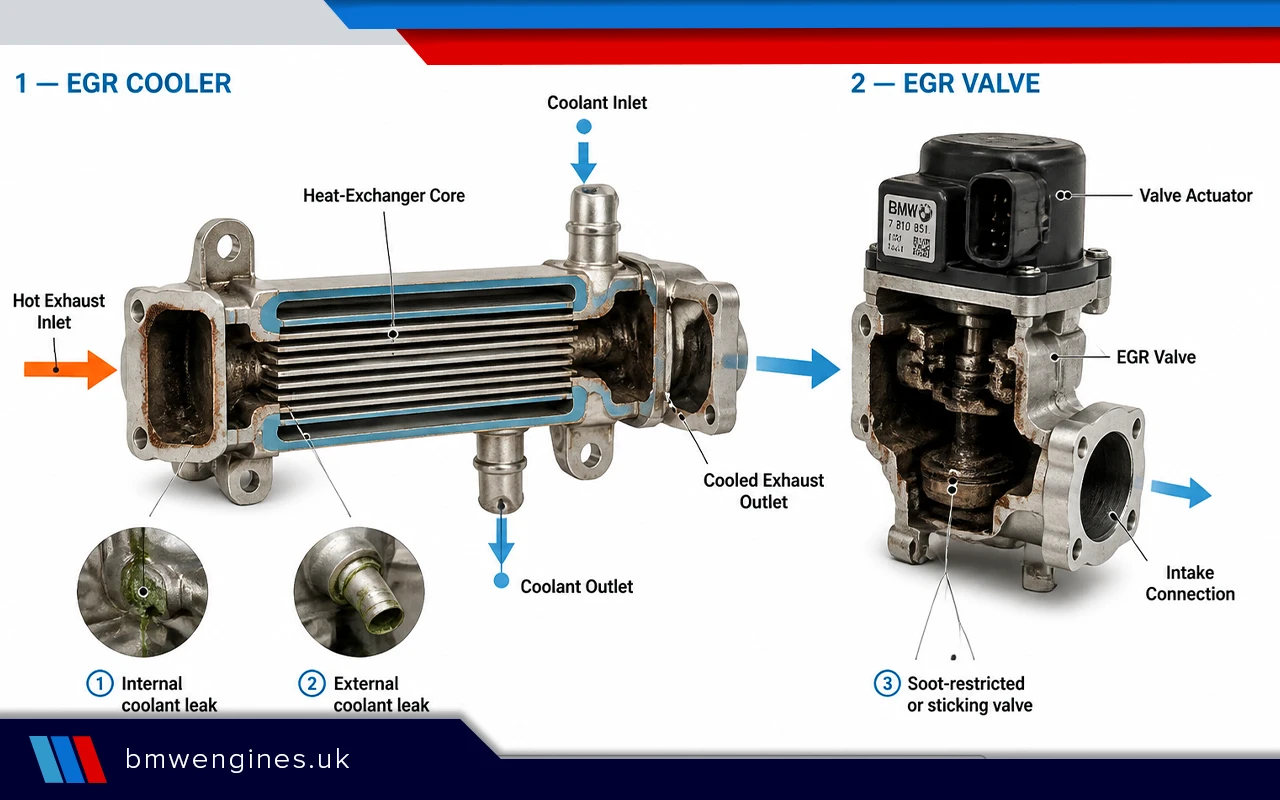
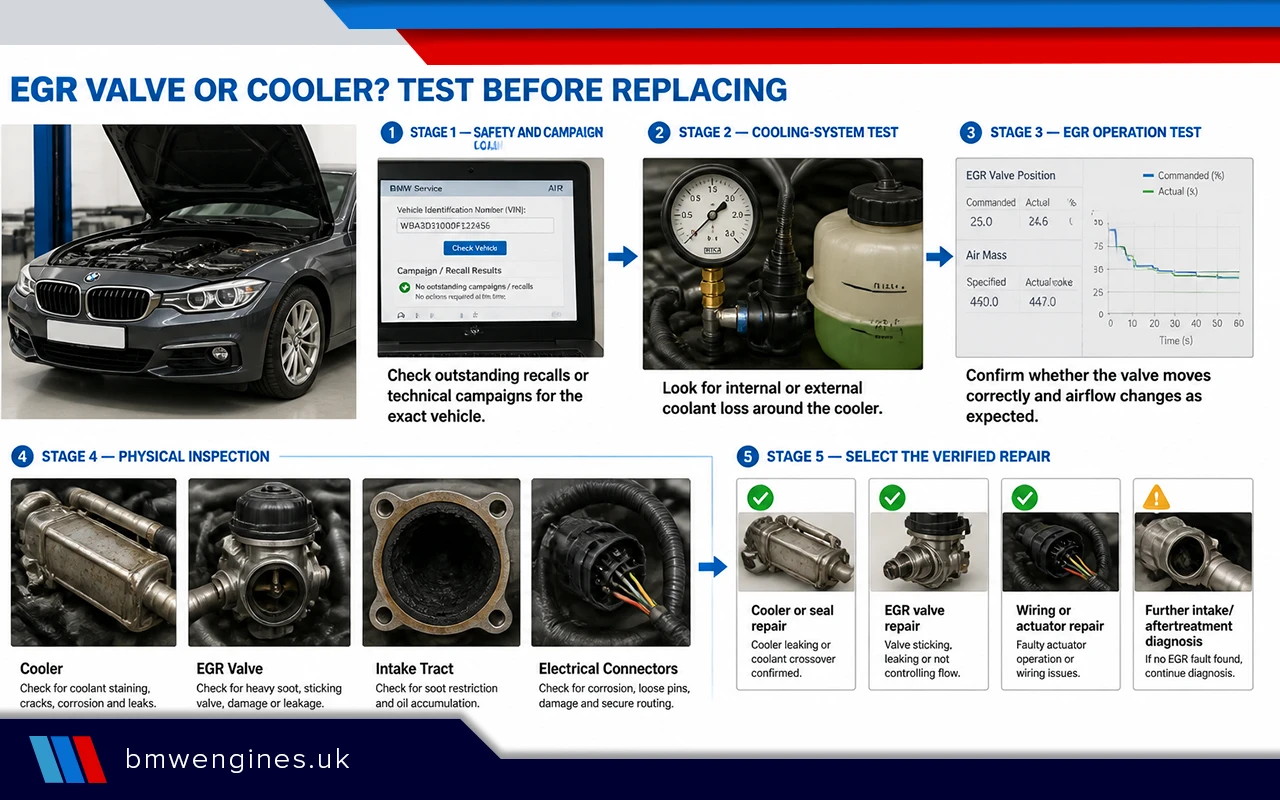
Verify the EGR cooler has been replaced under recall.
Verdict: "A major engine failure on an E70 X5, especially the V8, is likely to cost more than the car is worth. Buy only with a full service history and budget for preventative work."
F15 (2013–2018) — The Most Popular X5
The F15 is the most-enquired X5 generation in our data, with 288 requests [EM-VERIFIED]. It uses the same N57 and N63 engines as the E70 but with higher host values, making replacement more economically viable—but still a watch.
What changed: The F15 introduced a lighter, more aerodynamic body and improved interior technology. The engines remained largely the same as the E70.
What breaks: Same as the E70—N57 timing chain stretch and N63 hot-vee failures. The F15's higher value means a £5,750 N57 recon is 58% of a £10,000 car【2†L16-L18】, which is expensive but not always a write-off.
What it's worth now: £10,000–£28,000. At the lower end, an N57 failure is a serious financial decision. At the upper end, it's a painful but manageable repair.
Buying checklist:
Same as E70 for N57 and N63 checks.
Prioritise B57 diesel models if available—they're the engine to have.
Check for oil consumption on N63 cars—it's a sign of valve seal wear.
Verify the timing chain has been inspected or replaced on high-mileage N57 cars.
Verdict: "F15 X5s with N-series engines are a watch: replacement costs £4,500–£7,000 on a car worth £10,000–£15,000. This is an expensive repair but not always a write-off. Check the engine code."
G05 (2018–present) — The Generation to Buy
The G05 is the only X5 generation with the B57 and B58 engines—and it's the one to buy. Replacement cost is under 30% of the car's value, making engine failure a routine repair rather than a financial catastrophe.
What changed: The G05 introduced the B57 3.0-litre diesel and B58 3.0-litre petrol engines. These are BMW's modular B-series engines, which are significantly more reliable than the N-series they replaced.
What breaks: Minor issues only. The B57 has coolant leaks from the expansion tank and DPF clogging in urban use【4†L9-L10】. The B58 has coolant leaks (water pump, expansion tank, plastic fittings) and PCV valve failure【4†L13-L14】. None of these are engine-ending—repairs are £300–£1,000.
What it's worth now: £25,000–£65,000. Replacement cost is a fraction of the car's value.
Buying checklist:
Check coolant level—leaks are the most common B57/B58 issue.
For diesel, check DPF condition—urban use can cause clogging.
Verify full BMW service history—essential for modern engines.
No major red flags—the G05 is fundamentally sound.
Verdict: "G05 X5s are safe. Replacement cost is well under 30% of the car's value. If you can afford the purchase price, the engine economics are favourable."
Which Generation to Actually Buy
G05. It's the only generation with the reliable B-series engines and the strongest financial case for replacement. If budget doesn't stretch, F15 with a B57 diesel is the next-best option—but avoid N63 V8s.
The G05's B57 engine scores 76/100【2†L20-L22】, matching the E53's M57 but with better replacement economics (20/20 vs 8/20). The B58 petrol is equally reliable. Either way, you're buying into BMW's most reliable engine family.
If you're on a tighter budget, an F15 with a B57 diesel is a good compromise—just check the service history and budget for a timing chain inspection at 80,000 miles. Avoid the N63 V8 entirely.
Methodology & Limitations
Data sources: All request volumes are from our internal CRM, covering 24,650 unique UK engine enquiries in 2025. Recon costs are from supplier quotes [EM-QUOTE] sent through our platform. Vehicle values are third-party market data [THIRD-PARTY] from Auto Trader, Motors.co.uk, and AutoUncle UK market data 2025.
What the data CAN tell you: Which X5 generations generate the most enquiries, what the typical replacement costs are, and what the documented failure patterns look like.
What the data CANNOT tell you: Enquiry volume does not equal failure rate. The F15's 288 enquiries reflect its popularity—not necessarily that it fails more often than other generations. Vehicles that never fail never contact us.
Evidence confidence: High — Based on 288 (F15), 218 (E70), 174 (G05), and 73 (E53) [EM-VERIFIED] enquiries, with well-documented failure patterns in the data file【2†L24-L26】.
Data vintage: Based on UK enquiry data from January–December 2025. Vehicle value data is from Auto Trader and Motors.co.uk 2024–2025.
FAQ
Which BMW X5 generation is most reliable?
The G05 with the B57 diesel or B58 petrol is the most reliable X5 generation. The B57 and B58 engines have minor issues—coolant leaks, PCV valve failure, DPF clogging—but none are catastrophic or engine-ending. The E53 with the M57 diesel is also reliable, but its age and low value make it a scrap risk. The E70 and F15 with N57 and N63 engines are the least reliable.
Is a high-mileage G05 safe to buy?
Yes, if it has a full service history. The B57 and B58 engines are robust and can reach high mileages—the B57 is rated for 100,000–180,000 miles before major issues【4†L9-L10】. Budget for a coolant system inspection at 80,000 miles and a DPF check if it's been used mostly in urban areas.
Why does the F15 have so many engine enquiries?
The F15 is the most-enquired X5 generation in our data, with 288 requests [EM-VERIFIED]. This reflects its popularity—it was a high-volume model and is now at an age where engine replacements are common. The N57 and N63 engines both have known failure modes, and the F15's value (£10,000–£28,000) makes replacement a serious financial decision.
Is the N63 V8 ever worth buying?
Only if you're prepared for the running costs. The N63's hot-vee design leads to valve stem seal failure, turbo coolant line issues, and battery drain【4†L5-L7】. A recon costs £8,000 on average【2†L23-L25】. On an E70 worth £5,000, that's a write-off. On an F15 worth £20,000, it's an expensive repair but not terminal. If you must have a V8, buy the G05 with the updated N63—but the B58 petrol is the better choice.
Closing Verdict
The G05 is the X5 generation to buy. It's the only generation with the B57 and B58 engines, which are reliable, repairable, and economically viable to replace. If budget doesn't stretch, an F15 with a B57 diesel is the next-best option—but avoid the N63 V8 entirely.
The E53 is a classic, but its low value makes it a scrap risk. The E70 is a financial gamble—N57 and N63 failures are common and expensive.
The most important takeaway: generation choice determines the financial outcome of an engine failure. A G05 owner pays £6,500 for a recon on a £25,000 car—26% of the value. An E53 owner pays £2,500 on a £2,000 car—125% of the value. The difference is the difference between a repair and a write-off.
Need a Replacement BMW Engine?
Get an instant quote for reconditioned or tested low-mileage BMW engines with full warranty coverage.